


By the MIA Sustainability, Digital Economy and Services Team
Accountancy and finance professionals are accustomed to the detailed and methodical process of closing the books and financial reporting. Increasingly, that same discipline is being applied to a new and complex area — measuring and reporting a company’s environmental and social impact. What was once a few pages on corporate social responsibility in an annual report has evolved into a data-intensive and highly scrutinised discipline. The sheer volume of information, from utility bills and emission reports to employee surveys, can be overwhelming.
This growing challenge has prompted a search for smarter solutions. What if technology could go beyond endless spreadsheets and manual data entry — not only handling compliance, but also unlocking strategic insights? A recent webinar, “Beyond Compliance: Leading with Artificial Intelligence (AI) and Sustainability,” hosted by the Malaysian Institute of Accountants, brought together experts to discuss this very topic. Featuring insights from Steven Chong of the MIA Digital Technology Implementation Committee, Manohar Johnson of the MIA Council and MIA Sustainability Committee, and Dr Matthew Wong, Founder and CEO of CarbonGPT, the session painted a clear picture: AI is no longer a futuristic concept in sustainability; it’s an operational reality that is reshaping the profession.
The Evolution of Sustainability Reporting
Manohar perfectly captured the journey many companies have undertaken. “In the initial years, sustainability reports were just maybe a couple of pages or so,” he recalled. “Over time, as stakeholders and regulators demanded more, these sections grew. The response was often to turn to a familiar tool – the spreadsheet. You started to see more extensive use of Excel sheets, which I think today is still very pervasive,” Manohar noted.
While spreadsheets are powerful, they have their limits when dealing with the scale of sustainability reporting. This manual process is not just time-consuming, but it’s also expensive and fraught with potential for error. Dr Matthew shared that companies were spending three to six months and over RM50,000 to RM200,000 per reporting cycle on carbon accounting, with teams drowning in spreadsheets and struggling to keep up with evolving frameworks. It was this bottleneck and the aim to make sustainability reporting efficient for businesses of all sizes that inspired him to leverage AI, leading to the creation of his company—Carbon GPT.
How is AI Transforming Sustainability Reporting?
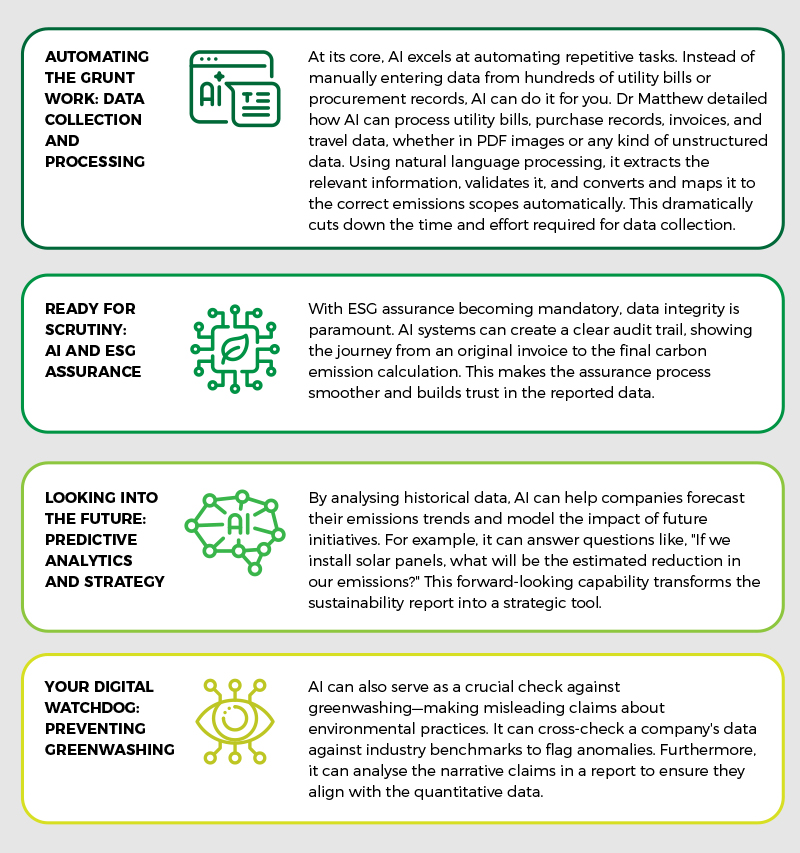
AI’s capabilities are both broad and deep, transforming every stage of the reporting process. The global market for AI in ESG and sustainability is projected to grow significantly, with some estimates suggesting that it could reach over USD846 billion by 2032.¹
The panellists shared insights on how AI is revolutionising sustainability reporting — from automating complex data collection and verification processes to transforming reports into powerful strategic tools that drive real environmental and business impact.
Upholding Ethics in the Age of AI
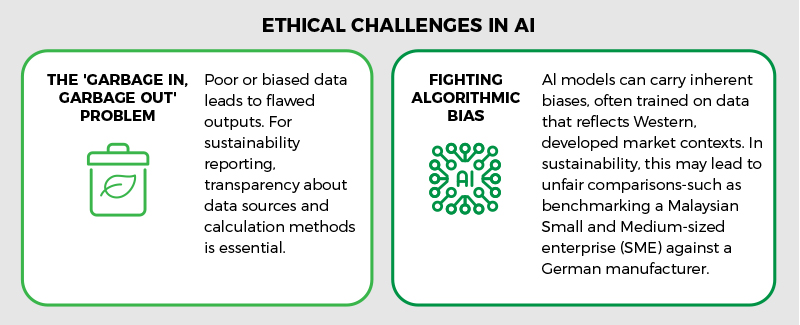
As the discussion unfolded, Steven steered the conversation toward a crucial issue – the ethics of entrusting AI with essential tasks. The idea of delegating such responsibilities to algorithms naturally raises important ethical questions. As Dr Matthew aptly remarked, “AI without ethics is like accounting without auditing.”
Making AI Explainable
Dr Matthew highlighted that when stakeholders cannot see how an AI system arrives at its conclusions, trust quickly erodes. This is where “Explainable AI” (XAI) becomes essential. Ethical use of AI should do more than deliver a figure – it should reveal the what, how, why, and source behind its outcomes, as well as acknowledge its limitations.

The New Role of Accountants
“If technology can automate compliance, what new value should accountants be creating instead?”
The question, raised during the Q&A session, challenged the profession to think ahead and reflect on its evolving purpose.
Manohar explained that as technology automates compliance, accountants have a vital opportunity to move beyond traditional financial reporting and become sustainability leaders, in line with the overarching aspirations for accountants outlined in the MIA Sustainability Blueprint for the Accountancy Profession.³ He highlighted that sustainability reporting is not merely about disclosing metrics – it is about informing strategic decision-making, managing risks, and driving long-term shareholder value. Accountants, he said, are well positioned to influence these decisions in this new role.
Where Do We Go from Here?
The convergence of AI and sustainability is a pivotal moment for the accountancy profession. It signals a shift from rearview-mirror compliance to forward-looking strategic guidance. As automation takes over the repetitive and routine, accountants and finance professionals are uniquely positioned to become architects of sustainable value — guiding organisations in decisions that balance profit, people, and the planet.
By embracing AI responsibly, with ethics at the core, the profession can elevate its role from recording the past to shaping the future. With smarter tools, more efficient processes, and boundless opportunities, accountants and finance professionals have the chance to move beyond compliance — to lead with purpose and help build responsible and sustainable organisations of tomorrow.
¹ Yahoo Finance. (2025, August 28). AI in ESG & sustainability market set to surge to USD846.75 billion by 2032. https://finance.yahoo.com/news/ai-esg-sustainability-market-set-153000334.html
² IBM. What is explainable AI? https://www.ibm.com/think/topics/explainable-ai
³ Malaysian Institute of Accountants. (2024, June). MIA Sustainability Blueprint for the Accountancy Profession. https://mia.org.my/wp-content/uploads/2024/06/MIA-Sustainability-Blueprint-for-the-Accountancy-Profession_2.0.pdf