

By MIA Sustainability, Digital Economy and Services Team
Artificial Intelligence (AI) has woven itself into the fabric of our daily existence, a silent yet powerful force shaping how we live, work, and interact. But as organisations race to adopt AI for efficiency and innovation, experts caution that trust, risk, and security must be treated as inseparable pillars of responsible AI.
These issues were explored during the second week of the MIA Digital Month 2025 webinar series in a session titled “Building Trust and Managing Risks in AI,” which drew over 700 participants. Moderated by Bryan Chung from the MIA Digital Technology Implementation Committee and Chair of MIA AI Advisory Group, the panel featured Jason Yuen, Partner in Technology Consulting and Cybersecurity at Ernst & Young Sdn Bhd; Jeanne Viljoen, Principal of Standards Development & Technical Projects at the International Ethics Standards Board for Accountants (IESBA); and Mohd Amir Syafiq bin Ab Halim, Manager of AI Innovation Exchange at the National AI Office (NAIO).
Steering AI with Trust
Opening the discussion, Bryan Chung noted that AI presents multifaceted challenges. “It’s not just about developing sophisticated algorithms. It’s equally about ensuring these algorithms are secure, respect our privacy, and operate within an ethical framework.”
He explained the concept of AI TRiSM, coined by Gartner, as an approach to good governance:
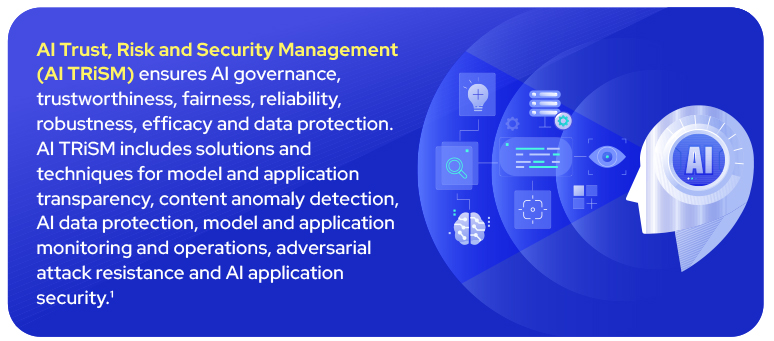
Expanding on this theme, Jason Yuen emphasised that trust, risk, and security are strongly interrelated components. “I would say that trust is probably a very huge component or core pillar in this whole area. A breakdown in security and a higher level of risk would impact your overall trust,” explained Jason. He illustrated the point with a simple analogy: if a calculator is trained on open data across the internet rather than on fixed mathematical rules, “you would potentially get answers where 2 plus 2 does not equal 4,” undermining reliability and trust.
Upholding Ethics in AI
Shifting the conversation to professional ethics in guiding the use of AI and emerging technologies, Jeanne Viljoen emphasised the need to integrate ethical considerations from the earliest stages of development and to ensure that users understand how data is processed and how decisions are made.
Professional accountants, she noted, must consistently apply critical thinking and professional scepticism. “Having that critical thinking and professional scepticism in all actions is key. You should remember having that mindset when using technology as the buck stops with you as a professional accountant.”
Jeanne also highlighted the technology provisions in the Code of Ethics, effective December 2024, which strengthen the Code in guiding the mindset and behaviour of professional accountants when engaging with technology.

From Silos to Unified Governance
A key challenge for organisations adopting AI is ensuring that trust, risk, and security are not treated in isolation. In practice, organisations should foster a unified approach to managing these three elements rather than allowing each to operate independently.
Amir Syafiq shared pragmatic steps for breaking organisational silos:
- Establish an AI governance council with representatives from IT, security, risk, compliance, legal, ethics, finance and other relevant functions.
- Develop or adopt an AI lifecycle framework incorporating trust checkpoints, risk assessment, and security tests.
- Implement integrated metrics using a shared KPI dashboard to track items such as the percentage of model-based documentation, number of security incidents, and stakeholder trust scores.
Practical Advice for Accountants and Leaders
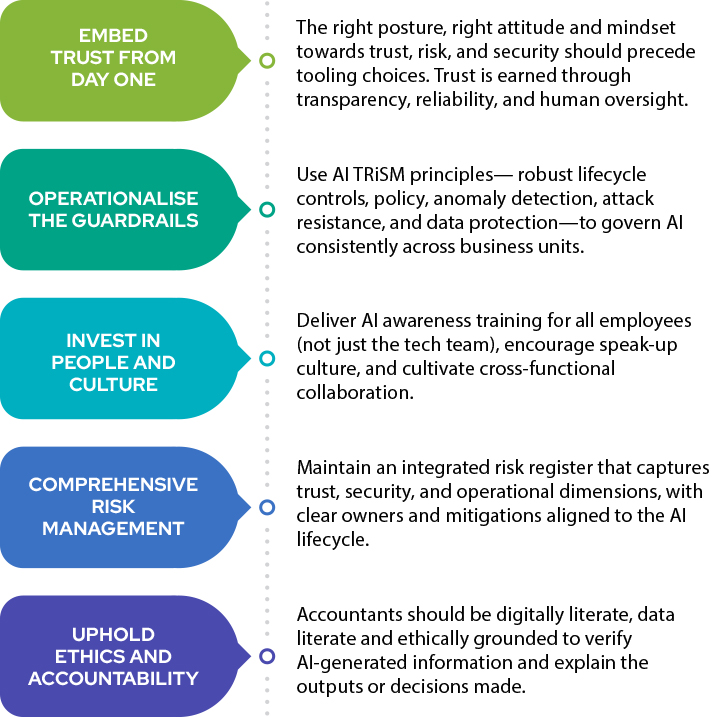
The panel shared several practical insights on building trust and managing the risks in AI:
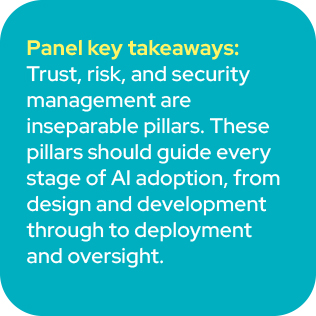
AI is no longer a distant prospect—it is becoming an integral part of the world, transforming how organisations operate, analyse data, and make strategic decisions. While AI presents significant opportunities for efficiency, insights, and innovation, it also brings challenges around trust, risk, and security management.
Looking ahead, MIA remains committed to supporting its members and the public in navigating the evolving landscape of artificial intelligence. A key initiative in this effort is the MIA Digital Month 2026, set to commence in April 2026.
The MIA Digital Month 2026 will place AI at the heart of its agenda, examining the latest AI technological innovations, practical applications for the profession, and the governance and ethical considerations essential for responsible adoption. Through engagement with industry experts and real-world case studies, accountants will gain the knowledge and tools necessary to leverage AI responsibly, manage associated risks effectively, and uphold professional trust.
¹ Gartner, Inc. (2024, 24 December). Tackling trust, risk and security in AI models. https://www.gartner.com/en/articles/ai-trust-and-ai-risk