


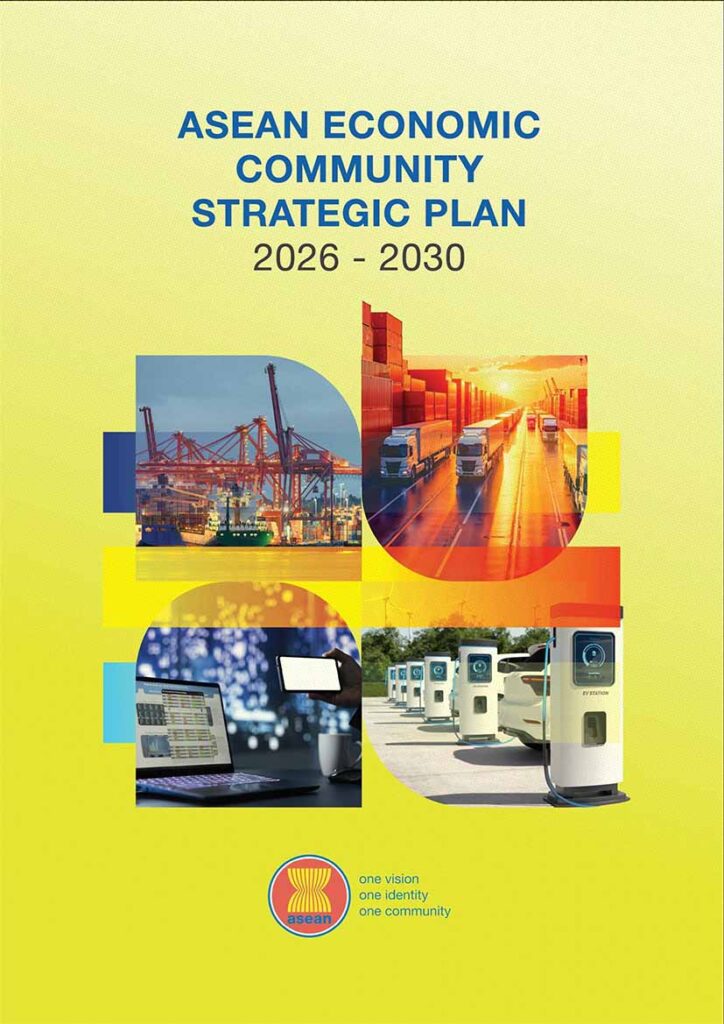
One of the world’s most dynamic economic blocs, the ASEAN Economic Community (AEC) is positioning sustainability and circularity as key levers for long-term competitiveness. Regional blueprints such as the Framework for Circular Economy for the AEC (2021) and the AEC Strategic Plan 2026–2030 emphasise sustainable economic practices, harmonisation of standards, and resilient supply chains that enable circularity across industries and borders. Key to achieving this is the availability of high-quality, decision-useful data—an area in
which the accountancy profession excels.
As sustainability gains traction in ASEAN, accountants are increasingly taking on expanded roles as custodians of sustainability information, providers of reliable disclosures, and assurance partners to businesses navigating the transition to low-carbon and regenerative models. From embedding lifecycle and circularity metrics into business planning to assuring green finance and equipping SMEs with realistic sustainability roadmaps, the profession is expected to be at the vanguard of shaping the region’s sustainable future. But this calls for significant upskilling to address the requirements for enhanced sustainability disclosures, and shift mindsets beyond compliance toward sustainable value creation.
Aligning with Global Standards – Enabling Value-Driven Disclosure
The rapid advancement of sustainability reporting globally pivots around the International Sustainability Standards Board (ISSB) standards, namely IFRS S1 on general sustainability disclosures and IFRS S2 on climate-related disclosures.
In Malaysia, the Malaysian Institute of Accountants (MIA) as the regulator and developer of the profession is advocating strongly on the implementation of the National Sustainability Reporting Framework (NSRF) that is aligned with IFRS S1 and S2. MIA views the NSRF as a catalyst to strengthen corporate resilience, improve market competitiveness, and ensure Malaysia remains attractive to global investors. In addition to preparing accountancy professionals for the NSRF, MIA has issued, for adoption in Malaysia the International Standard on Sustainability Assurance (ISSA) 5000, by the International Auditing and Assurance Standards Board (IAASB), which will provide a global baseline for high quality, consistent and credible sustainability assurance engagements.
MIA’s stance, as articulated in the MIA Sustainability Blueprint for the Accountancy Profession (issued in 2024), is that accountants are uniquely placed to embed sustainability into governance, risk management, strategy, and performance, driving long-term value creation. Guided by the MIA Sustainability Blueprint and MIA Sustainability Roadmap (2025–2029),
MIA is delivering 169 initiatives over a five-year span for advocacy, competency and capacity building, including structured upskilling, CPD programmes, and technical tools and guidance to equip members with new competencies in sustainability reporting, sustainability assurance, sustainability-related risk management and others.
Yet capacity gaps, immature data, and compliance costs—especially for smaller entities—remain as significant barriers across ASEAN. This underscores the need for scalable, affordable, and technology-enabled solutions.
These challenges are exacerbated by resistance to change. Accountants are trained to measure, disclose and comply, but sustainability demands more than technical competence. Success requires a mindset shift to strategic and integrated thinking. In particular, IFRS S2 emphasises the integration of climate risks into enterprise risk management (ERM) and strategic planning to enable organisational resilience, innovation, and long-term value. Governance is critical to reinforce this shift. Strong sustainability governance and tone from the top are the key factors ensuring that insights from data inform decision-making and sustainable outcomes in the long run.
Preparing the Profession for Green Finance, Carbon Accounting and Biodiversity Reporting
Complementing the move to sustainability reporting, MIA is emphasising upskilling on green finance, carbon accounting, and biodiversity reporting which are key to delivering on decarbonisation targets. As part of their expanding roles, accountants are increasingly expected to measure, verify, and interpret emissions data, assess environmental risks, and advise on climate strategies.
To upskill its more than 41,000 members, MIA’s initiatives include:
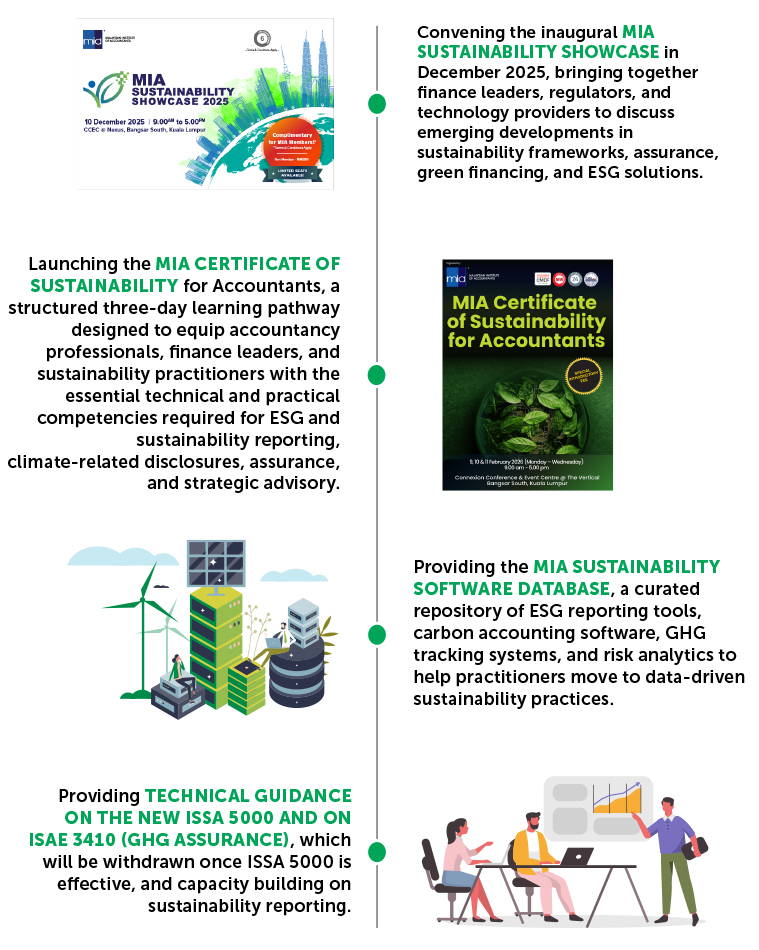
Key to the transition is familiarising accountancy professionals with the data intensive and technology-enabled nature of sustainability reporting. Drones, satellite imaging, AI, lifecycle software, and continuous data monitoring are increasingly used to capture accurate, credible, and comparable sustainability information. Accountants must therefore be comfortable analysing and assuring digital data streams, assessing technology-derived metrics, and integrating sustainability risks through ERM and strategic decision-making.
As these capabilities advance, the profession must also ensure that all organisations— including SMEs—can participate meaningfully in the sustainability journey. Limited resources, lack of expertise and high compliance costs mean SMEs need guidance to implement meaningful sustainability practices. Accountancy professionals and small and medium practices (SMPs) are pivotal in helping SMEs overcome these hurdles, ensuring that sustainable transformation is broad-based. By supporting SME inclusion, the profession helps build a more resilient, diverse, and inclusive regional economy where sustainable practices benefit many stakeholders.
Conclusion: Positioning ASEAN Accountants as Trusted Advisors and Drivers of Sustainable Value
ASEAN stands at a crossroads. With global supply chains demanding credible sustainability performance and investors expecting trustworthy ESG disclosures, the region’s competitiveness increasingly hinges on the quality and accessibility of sustainability information. Accountancy professionals—embedded in every organisation—are central to meeting these expectations.
By aligning with ISSB standards, embracing digital tools, enabling SME participation and strengthening assurance and governance, ASEAN accountancy professionals are becoming strategic enablers of sustainable value. Their ability to integrate sustainability risks into decisions, assure green finance and leverage technology for transparent reporting positions them as indispensable partners in building a future-ready ASEAN.
To sustain momentum, the profession must continue to upskill, collaborate, and shift decisively from mere compliance to driving impact. Anchored by strategic frameworks and a shared commitment to ethics and sustainable development, ASEAN accountants are well positioned to help lead the region toward a more resilient, inclusive, and competitive future.
This article originally appeared on the AFA Connect 16. Copyright © 2025 by the ASEAN Federation of Accountants (AFA). All rights reserved. Used with permission of AFA. Contact AFA Secretariat [email protected] for permission to reproduce, store, or transmit this document.