


By MIA Sustainability, Digital Economy and Services
Digital transformation is increasingly essential for small and medium-sized enterprises (SMEs) and small and medium-sized practitioners (SMPs) in Malaysia. It is closely linked to competitiveness, productivity, and long-term growth (Sepashvili, 2020).
At first glance, digitalisation appears to be a question of resources (e.g. Faruque et al., 2024; Rao et al., 2023; Zhang et al., 2022), including whether firms have the financial capacity, systems, and talent to adopt new technologies. In practice, the issue runs deeper.
As highlighted in a study commissioned by the Malaysian Accountancy Research and Education Foundation (MAREF), one of the key challenges faced by SMPs and SMEs is securing adequate resources. The study, titled Funding Methods for Technology Adoption by SMPs and SMEs: Past, Present and Future, was conducted under MAREF’s Priority Research Topic (PRT) 3.0 Programme.
Why Government Funding Matters More Than It Appears
Among these resource constraints, access to financing is particularly important because it determines how far firms can progress in their digital transformation journey.
The research findings show that most SMEs primarily depend on internal funding, such as retained earnings and operational cash flow, to finance their digital transformation initiatives. While this approach offers greater flexibility and control over investment decisions, it also constrains the scale and pace of technology adoption. Although internal funding is generally sufficient to support the implementation of basic digital tools, more advanced technologies often require a level of investment that exceeds the capacity of internally generated funds alone.

Where internal funding is insufficient, firms may turn to external sources of financing to support larger-scale technology investments. While external funding, such as bank loans and other financing facilities, has the potential to support larger-scale technology investments, access to such funding remains uneven in practice. Stringent eligibility criteria, repayment obligations, and financial risk considerations often prevent many SMEs from qualifying for these financing options or discourage them from pursuing them altogether.
These limitations highlight the potential of Government funding in supporting digital transformation. Government funding plays a distinct role in supporting digital transformation. Although our online survey found that it is less commonly utilised than internal funding, it has a significant impact on firms that are able to access it.
Businesses that benefit from Government grants or incentives are more likely to progress beyond basic digital adoption and invest in more advanced technologies. In this regard, Government funding not only facilitates digitalisation but also enables firms to achieve a higher level of technological advancement.
At the same time, uptake remains limited. Many businesses are either unaware of available programmes or deterred by application processes and administrative requirements. As a result, funding that could drive meaningful digital transformation does not always reach the firms that need it most. In Malaysia, several initiatives have been introduced to provide financial support to businesses undertaking digitalisation. Examples of funding assistance currently available include the Geran Digital PMKS Madani (GDPM) and the Business Digitalisation Initiative by the Malaysia Digital Economy Corporation (MDEC).
A Practical Way to Think About Digital Adoption
The significance of funding becomes clearer when digital adoption is considered within the broader journey of digital transformation, progressing through different stages of digital maturity.
Drawing on the findings of this study, the following framework was developed as part of the research, to help organisations assess their level of digital transformation:
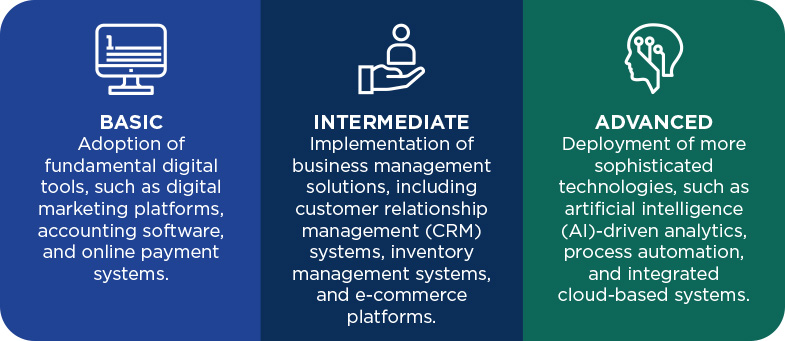
Our findings indicate that while most SMEs are able to achieve the basic stage of digitalisation, progressing to the intermediate and advanced stages depends largely on access to adequate funding, as well as the organisation’s internal capabilities and readiness for digital transformation.
Beyond Funding: The Capability Constraint
However, access to funding alone does not determine whether firms can progress to higher levels of digital maturity. Firms with stronger internal capabilities, particularly in terms of robust technological infrastructure and a skilled workforce, are better equipped to adopt and implement digital technologies effectively. These firms are also more likely to secure available funding and utilise it efficiently to support their digital transformation initiatives.
This creates a reinforcing cycle: organisations with stronger capabilities are able to accelerate their digital transformation journey, while those with more limited resources and capabilities often remain at the basic stages of digital adoption.
What Needs to Change
The findings highlight that improving access to funding alone is insufficient to drive successful digital transformation. Equally important is ensuring that financial support is complemented by the necessary technical capabilities, organisational capacity, and other intangible resources to enable effective implementation (see also Bidoia, 2024).
For policymakers and the accountancy profession, this underscores the need to:
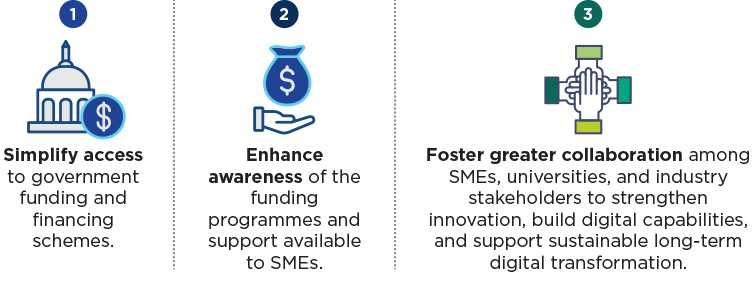
At the same time, firms need to strengthen their internal capabilities by developing the necessary skills, systems, and processes to effectively leverage available resources and maximise the benefits of their digital transformation initiatives.
Moving Forward
Taken together, these findings point to the need for a more integrated approach to financing and capability development. Digital transformation among Malaysian SMEs and SMPs is influenced by both the availability of funding and the internal capabilities of individual firms. While many organisations can embark on their digital transformation journey, comparatively fewer are able to scale and sustain their digital initiatives.
Bridging this gap will require financing mechanisms and supporting initiatives to be better aligned with the practical needs of businesses, enabling them not only to adopt digital technologies but also to implement and sustain them effectively over the long term.
References
Giacomo , B. (2024). Non-Financial Reporting impacts SMEs – Sustainability reporting practices for Small and Medium Enterprises. https://unitesi.unive.it/retrieve/354bec57-0022-4da5-be89-ef769c183b53/872346-1291863.pdf
Rao, P., Kumar, S., Chavan, M., & Lim, W. M. (2021). A systematic literature review on SME financing: Trends and future directions. Journal of Small Business Management, 61(3), 1–31. https://doi.org/10.1080/00472778.2021.1955123
Sepashvili, E. (2020). Supporting Digitalization: Key Goal for National Competitiveness in Digital Global Economy. Economia Aziendale Online. https://doi.org/10.13132/2038-5498/11.2.191-198
Zhang, X., Xu, Y., & Ma, L. (2022). Research on Successful Factors and Influencing Mechanism of the Digital Transformation in SMEs. Sustainability, 14(5), 2549. https://www.mdpi.com/2071-1050/14/5/2549
Faruque, M. O., Chowdhury, S. N., Rabbani, Md. G., & Khan, N. A. (2024). Technology Adoption and Digital Transformation in Small Businesses: Trends, Challenges, and Opportunities. International Journal For Multidisciplinary Research, 6(5). https://doi.org/10.36948/ijfmr.2024.v06i05.29207
This article is written by a team of researchers from Universiti Malaysia Kelantan (UMK) for a research project under the MAREF PRT Programme by MAREF, a foundation established by the Malaysian Institute of Accountants (MIA). The researchers are led by Dr. Siti Afiqah Binti Zainuddin. Other team members are Prof. Madya Dr. Noorul Azwin Binti Md Nasir, Dr. Tahirah Binti Abdullah, and Dr. Amira Binti Jamil.
The views expressed are not the official opinion of MAREF, its Trustees, MIA, its Council or any of its Boards or Committees and staff. Neither MIA, its Council nor any of its Boards or Committees, nor its staff shall be responsible or liable for any claims, losses, damages, costs or expenses arising in any way out of or in connection with any persons relying upon this article.
The study operationalised a mixed-methods approach, using focus group discussions, an online survey polling 384 respondents, and semi-structured interviews to yield qualitative and quantitative data.